
Local visibility used to be easier to define. For aesthetic practices, it often meant appearing in search results, showing up in map listings, and building enough SEO strength to compete in a specific city or market.
However, as patients encounter more AI-generated summaries, conversational search responses, and search results that synthesize information from multiple sources, local visibility is increasingly dependent on a broader set of authority signals.
AI Search Raises the Stakes for Local Authority
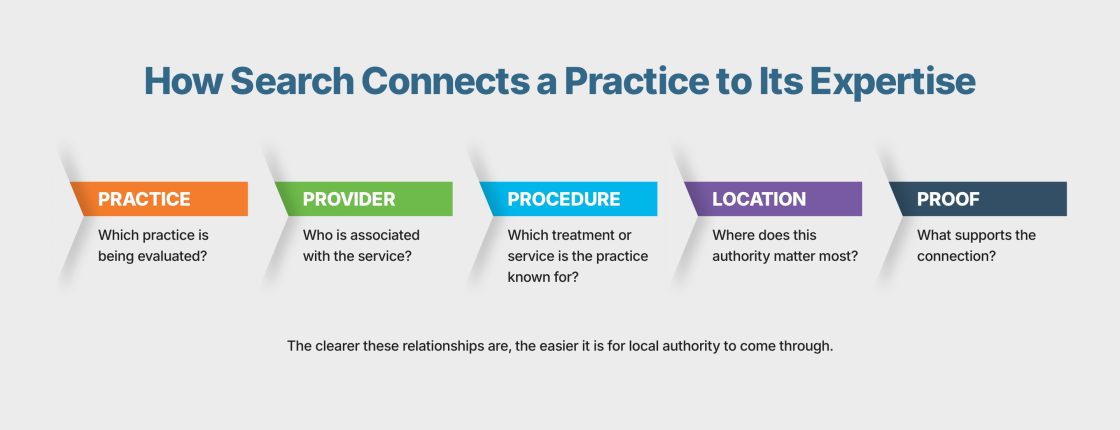
AI-driven search does not evaluate a practice from one page alone. It looks for patterns of support that help confirm what a practice is known for and when it should be part of the answer.
This changes the role of the procedure page. A facelift page, for example, may explain the service well, but it cannot carry the full context around the provider, the patient experience, or the practice’s reputation on its own.
The new pressure point is the digital ecosystem surrounding the practice. Local authority is not just about being visible in a particular city or market, but about making the practice’s expertise easier to recognize wherever patients and search systems are forming an impression.
A Smaller Footprint Can Still Carry Strong Authority
A smaller practice may not have the largest footprint in the market, but it may have something more valuable: a stronger association with the services patients are actually searching for. For elective healthcare practices, that specificity can matter more than scale.
A larger competitor may appear in more searches, have more pages, or promote a wider range of services. But if a patient is looking for a facelift surgeon, an injectable specialist, or a practice known for a specific aesthetic concern, broad visibility is not the same as a strong answer.
AI-driven search appears to heighten that distinction. When a practice’s website, reviews, provider presence, and local reputation all reinforce the same areas of expertise, these strengths become easier to confirm. For smaller or more specialized practices, this creates an opening to compete where they are most relevant, not just where competitors are most visible.
Your Website Is the Starting Point, Not the Proof
A practice’s website is still the foundation of its visibility. It gives the practice space to define its services, explain its philosophy, highlight providers, and create content around the procedures patients are researching.
But the website is also the practice speaking for itself. In AI-driven search, that self-authored content becomes stronger when other sources add corroborating context. Reviews, Google Business Profile details, provider profiles, local listings, social activity, and third-party mentions can all help show that the practice’s online positioning is reflected beyond its own site.
Build Authority Where Patients and Search Systems Look for It
Aesthetic practices often have more authority than their online presence makes visible. A surgeon may be known locally for a procedure, a provider may have a loyal patient following, or a practice may have years of credibility in its market, but those strengths are not always easy to confirm across the practice’s online presence.
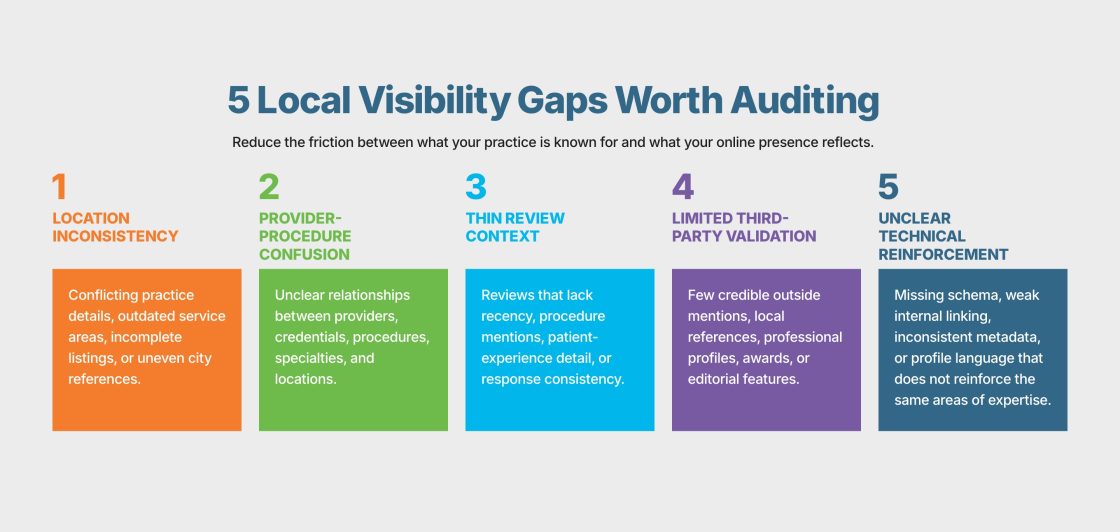
Rather than chasing every possible AI visibility tactic, the goal of local authority work is to close the gaps that make a strong practice look less established, less specific, or less trusted than it really is. In practical terms, that may mean:
- Cleaning up location inconsistencies
- Clarifying which providers are connected to which procedures
- Improving the specificity of review generation
- Strengthening Google Business Profile content
- Earning outside mentions that reinforce the practice’s standing in the market
The most impactful local authority work often comes from tightening what already exists. When the practice’s greatest strengths show up clearly across these channels, visibility becomes less dependent on any single page, post, profile, or platform.
Hyperlocal Strategy Is No Longer Just a Local SEO Play
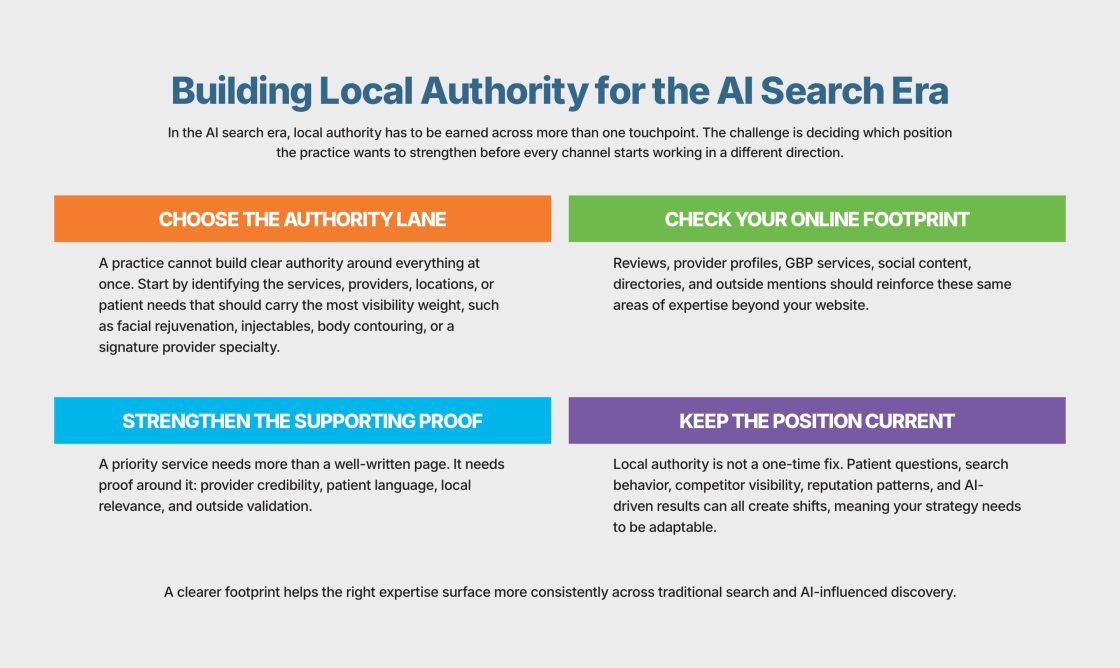
Hyperlocal strategy now has to give every visibility effort a shared market position to support. For aesthetic practices, that means deciding where the practice should be most clearly associated and making sure local SEO, reputation, content, and off-site visibility all reinforce that direction.
An effective strategy separates activity from priority. A practice may have multiple visibility efforts in motion, but not all of them carry the same strategic weight. The question is which services, providers, locations, or reputation gaps most need support to strengthen the practice’s position in traditional search and AI-driven discovery.
The Bottom Line
AI-driven search is changing how patients discover and compare aesthetic practices, but it is not replacing the fundamentals of local authority. It is putting more pressure on them.
The practices best prepared for this shift will be the ones that know what they should be known for, where that authority needs to show up, and how to strengthen the signals that support it over time. If you want help building a local authority strategy that supports SEO and AEO visibility, contact us to learn more or connect with our team.

Leave a Comment