
If you want your practice to appear in AI-generated answers, look beyond keywords alone and start strengthening the public signals that help answer engines understand and trust your brand. Platforms like ChatGPT, Perplexity, Claude, and Google’s AI Overviews are shaping how patients discover healthcare providers, and they increasingly use public signals of trust, relevance, and authority to help determine which brands are surfaced, summarized, or cited.
For elective healthcare practices wondering how to rank in AI search results, visibility no longer depends solely on where your website ranks. It also relies on whether your practice appears credible enough to earn a place in the answer itself.
Why Online Reputation Is Important in the Age of AI Search
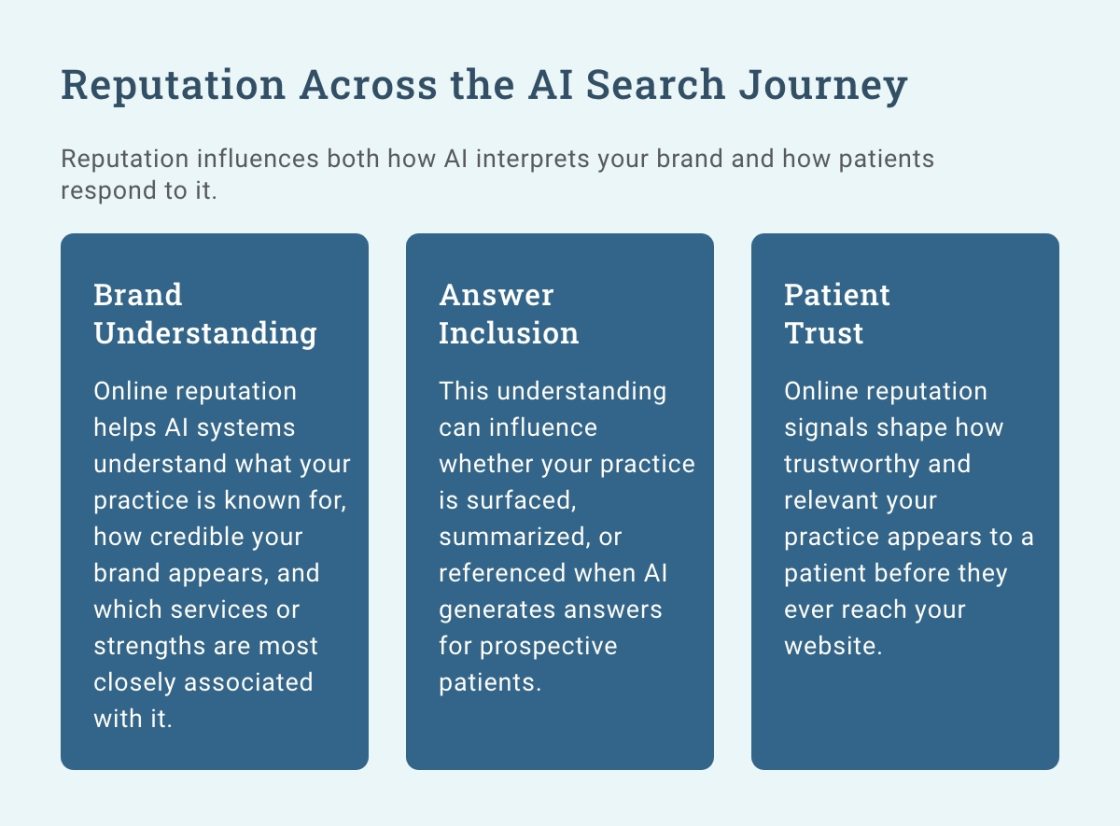
As AI platforms synthesize information across multiple sources instead of relying on page position alone, your online reputation carries more weight. A strong reputation can reinforce your authority, while inconsistent reviews, ratings, and other public feedback can make it harder for AI systems to form a clear picture of your brand.
Your digital footprint gives answer engines visible evidence of trust, relevance, and expertise across the web. It helps shape what your practice is known for and how credible your brand appears to AI systems when deciding what to reference in an answer.
Reviews are only one piece of that footprint. AI systems also look across your website, provider profiles, local listings, directories, awards, media mentions, and other trusted third-party sources to understand whether your reputation is consistent and well-supported.

From Rankings to Answer Inclusion: How Traditional and AI Search Compare
AI search changes the goal from winning a position on the page to earning a place in the answer. Here’s how the digital landscape is shifting.
| Consideration | Traditional Search | AI Search |
|---|---|---|
| Primary focus | Keyword targeting and page rankings | Brand understanding and answer relevance |
| Main goal | Driving clicks from the results page | Earning citations, mentions, and inclusion |
| Visibility model | Blue links and page position | Synthesized answers and answer references |
| What success looks like | Ranking higher | Being included in the answer |
How To Strengthen Your Reputation for AI Search
As online reputation plays an ever greater role in AI visibility, practices can no longer treat review generation as a passive byproduct of patient satisfaction. They need to make it a deliberate part of how they build authority in public.
Make Review Generation Part of Your Operations
Treat review cultivation as an operational discipline, not an occasional marketing initiative. Practices that inconsistently ask for patient reviews create uneven profiles. Practices that integrate review requests into the patient journey create stronger momentum and fresher signals over time. They also reduce friction by making the review process easy to access and complete.
Focus on Review Quality, Not Just Quantity
Patients should never follow a script, but your practice can still guide them. Prompts that encourage patients to mention the procedure they had, the concern they wanted to address, and what stood out in their experience often lead to more useful, descriptive reviews.
Align Review Themes With Your Expertise Strategy
For AEO, the most useful reviews are not just positive; they are specific, descriptive, and aligned with the services you want to be known for. If your practice wants stronger associations around a select group of high-value procedures, patient feedback should consistently reinforce that expertise. As competition for AI visibility increases, clearer expertise signals make it easier for AI platforms to connect your brand to the right services.
4 Ways Reviews Support AI Visibility
Reviews do not guarantee visibility in AI overviews or citations in answer engines, but they do strengthen the signals that make both more likely.
1. Volume Helps Validate Market Relevance
A larger volume of reviews provides AI with stronger evidence that patients actively choose your practice. Low review counts do not automatically signal low quality, but they do leave a thinner layer of public proof. More reviews create more corroboration and give answer engines more data points to evaluate.
2. Consistency Clarifies What Your Practice Is Known For
A practice with a high star rating built on generic praise sends a very different signal than a practice with a similarly strong rating supported by detailed, service-specific feedback. Both profiles may look healthy on the surface, but only one gives AI meaningful context about what that practice is actually known for.
When your reviews consistently reinforce the same strengths, services, and experience themes, they make your expertise easier for patients and AI systems to understand. If your website says you specialize in facial rejuvenation, but your reviews mostly mention unrelated services or broad praise with no clinical context, that association weakens.
3. Sentiment Reinforces Trust
Positive sentiment is not just a vanity metric. It signals that the patient experience aligns with the credibility your brand projects. Consistently strong sentiment around outcomes, communication, bedside manner, and overall experience helps turn visibility into trust across platforms.
4. Specificity Connects Your Reputation To Real Procedures
Generic reviews still have value, but they do less to reinforce your procedural relevance. A review that says “wonderful team” may read positively, but it gives little insight into what your practice actually does.
A review that mentions rhinoplasty recovery, facelift results, breast revision planning, or acne scar treatment is far more valuable because it strengthens the association between your brand and the procedures you perform.
Reputation Supports Visibility, But It Cannot Carry the Whole Strategy
Practices that want to appear in AI search results should not think in silos. Reviews matter, but they work best when they reinforce a broader AEO strategy. Clear positioning, strong provider pages, procedure authority, consistent messaging, and a well-managed digital presence all work together to help answer engines know who you are.

The Bottom Line
AI visibility does not reward reputation alone. It rewards clarity. Practices that pair strong public feedback with a clearly defined area of expertise give answer engines a better basis for understanding their expertise, strengths, and role in the answer.
If you want help building a reputation strategy that supports AI search, contact us to learn more or connect with our team.

Leave a Comment