Most medical and aesthetic practices should evaluate their website every year and plan for meaningful updates every 2 to 3 years. A full redesign may be needed sooner if the site is slow, difficult to manage, outdated visually, underperforming in search, or failing to convert visitors into patients.
Your website isn’t a static brochure. It’s an active part of patient decision-making. It should help prospective patients understand their options, trust your expertise, and feel confident taking the next step. When your site no longer reflects your brand, supports your marketing goals, or meets patient needs, small fixes may not be enough. For medical practices and med spas, the question is not only “how often should you update your website?” but also “what is your website preventing you from doing?”
How Do You Know When It’s Time To Update Your Website?
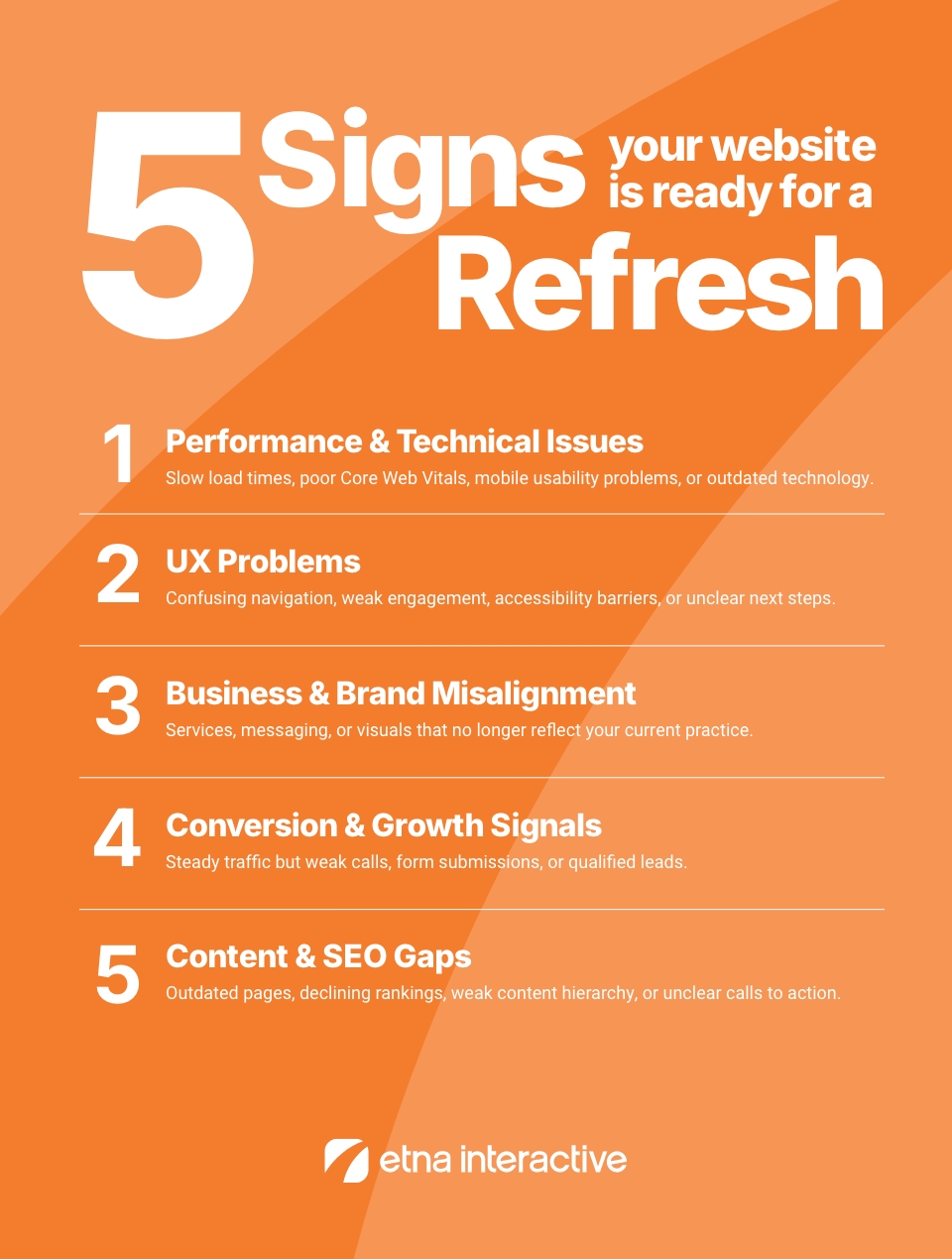
Consider updating your website when it no longer supports how patients research, evaluate, and connect with you. Below are 5 common signs your website may no longer be supporting your practice as effectively as it should.
5 Website Warning Signs Worth Taking Seriously
Use these 5 areas to evaluate where your website may be creating friction for patients or limiting marketing performance.
1. Performance: Your Site Is Slow, Outdated, or Hard To Maintain
Performance problems are one of the clearest signs your website needs attention. Slow load times, poor Core Web Vitals, outdated plugins, security concerns, or a rigid content management system can all affect user experience and search visibility.
Responsive website design matters even more in a mobile-first world. If your site looks acceptable on desktop but feels clunky on a phone, patients may leave before they ever reach your consultation form.
2. User Experience: Visitors Can’t Find—or Do—What They Need
Good website design should make the next step feel obvious. If patients struggle to find procedure information, pricing context, before-and-after photos, provider credentials, location details, or contact options, the site is creating friction.
However, user experience issues are not limited to navigation. Annoying or poorly functioning website elements can also get in the way, such as:
- Excessive pop-ups
- Intrusvie notifications
- Misaligned buttons
- Image or layout issues that affect readability
- Forms that are difficult to complete
- Pages that require too many clicks to reach important information
Patients rarely announce when a website experience feels frustrating; they simply leave. Common warning signs include:
- High bounce rates
- Low time on the page
- Weak engagement
- Confusing navigation
- Too many clicks to reach important information
3. Brand Alignment: Your Brand or Services Have Evolved
A website that was accurate 3 years ago may no longer tell the right story. Your practice may have added new treatments, shifted your positioning, refined your ideal patient profile, or moved into a more premium market.
A strong medical or med spa website should communicate who you are today, not who you were when the site launched.
4. Conversion: Traffic Is Steady, but Leads Are Weak
If you are getting visitors but not enough calls and form submissions, the issue may be conversion. Your site may lack clear calls to action, persuasive service pages, strong trust signals, or a patient journey that guides people from research to action.
A useful gut check: Are you proud to share your URL with a prospective patient, partner, or colleague? If not, that hesitation is worth listening to.
5. Search Visibility: Your Content and SEO/AEO Strategy Are Falling Behind
Knowing how—and how often—to update website content for SEO and AEO depends on your goals, market, and competition. Most practices should review their core service pages at least annually. High-value pages may need more frequent updates when search behavior changes, competitors improve their content, or new procedures become priorities.
Search visibility can decline gradually over time, but it can also shift quickly after algorithm updates, competitive changes, or changes in how AI-driven platforms surface answers. Pages with outdated information, weak internal linking, unclear structure, poor user experience, or stale content may lose visibility even if they performed well in the past.
For elective healthcare practices, a strong content strategy should include a regular maintenance plan—not just new content creation or occasional updates to priority pages. That plan should account for the full website experience, including older blogs and supporting content, so the site stays current as search behavior changes.
Website Refresh or Full Redesign?
Not every website challenge requires a full rebuild. The right scope depends on what needs to change, how much of the site is affected, and what you want the update to accomplish.
Website Refresh
A website refresh may be enough if your foundation is strong, and only one core area is underperforming.
Full Redesign
A full redesign may be the better choice if multiple areas are affecting usability, visibility, or conversions, or if the site is no longer a true reflection of your brand.
How Much Does It Cost To Update a Website?
The cost to update a website depends on the scope. A focused content, SEO, or design update may be a smaller project, while a full redesign requires a deeper investment in planning, execution, testing, launch support, and ongoing optimization.
For medical and aesthetic practices, the bigger question is often the cost of inaction. A dated or underperforming site can suppress lead volume, weaken patient trust, and limit the return on your broader marketing investment.
Why Work With an Elective Healthcare Web Design Agency?
Working with an elective healthcare web design agency gives your practice access to website strategy, patient-centered design, SEO, and marketing insight tailored to your specific market. In a category where patients are comparing expertise, outcomes, trust signals, financing options, and personal fit, these details shape how confidently they move from research to inquiry.
Website updates also involve connected decisions about:
- Content
- Usability
- Search visibility
- Accessibility
- Conversion paths
- Technical performance
When these decisions are made in isolation, a page may look better but still load slowly, rank poorly, bury the call to action, or miss the questions patients need answered.
The right partner helps you prioritize what to update first, what can wait, and how each improvement should support the larger patient journey. As a plastic surgery and medical spa web design agency and medical practice marketing partner, Etna Interactive brings that expertise to every recommendation, so your website updates have the most impact.
What Should You Bring To a Website Review?
Before a website review, it helps to gather what your team is already noticing: where patients may be getting stuck, which pages feel outdated, and what parts of the site no longer support your goals.
Website Review Readiness Checklist
Use the checklist below to organize your observations, so you can go to your review session with a clearer understanding of your priorities, scope, and desired next steps.
| Area | What To Review | What To Note |
| Mobile UX | Can patients easily browse, compare, and inquire from a phone? | Any pages, menus, forms, or galleries that feel difficult to use on mobile. |
| Speed | Do priority pages load quickly and smoothly? | Slow-loading pages, image-heavy sections, or performance concerns. |
| Content | Does your content offer a unique perspective compared with your competitors’ sites? | Pages that feel generic, mirror competitor content, or fail to show what makes your practice distinct. |
| SEO | Are priority pages structured around the right search intent? | Pages losing visibility, missing key topics, or lacking clear headings and internal links. |
| AEO | Can AI systems clearly identify your expertise, credentials, differentiators, and positioning? | Pages missing provider authority, procedure depth, structured differentiators, or clear positioning signals that AI systems can extract and surface. |
| Conversion | Are the next steps clear and easy to complete? | Calls to action, forms, phone links, consultation paths, or booking steps that could be clearer. |
| Brand Fit | Does the site reflect your current services, positioning, and patient experience? | Visuals, messaging, or page structure that no longer accurately represent the practice. |
How To Update Website Content the Etna Way
At Etna, website content updates bring together our strategy, copywriting, design, development, and marketing expertise to improve how the site supports patient decision-making and practice growth.
We start with the pages most closely tied to revenue and patient trust, such as key service pages, provider bios, and before-and-after galleries.
From there, we evaluate what each page needs to perform better: whether that means clearer messaging, stronger calls to action, improved usability, or better search visibility.
This cross-functional process helps a website update move beyond surface-level polish. Instead of treating content, design, SEO, and usability as separate fixes, we consider how these elements work together to help patients understand your practice, evaluate their options, and take the next step.
Is It Time To Update Your Website?
Your website should reflect who you are today and support where you want to go next. If performance, usability, content, SEO, conversion, or brand alignment are no longer working as well as they should, the next step is to determine the right level of update: a focused refresh, targeted improvements, or a more strategic redesign. Contact Etna Interactive to learn more or request a live expert consultation of your website and marketing performance.

Leave a Comment