

Patients increasingly form their first impression of a practice from an AI-generated answer, rather than from a webpage they click through to read. Google’s AI Overviews, ChatGPT, Claude, and other AI search tools summarize, compare, and recommend providers using information they can access and interpret across the web.
Clear, well-organized information makes it easier for these systems to understand a practice and connect facts about its providers, services, credentials, and locations. When that information is ambiguous, inconsistent, or difficult to extract, AI systems must rely more heavily on inference, increasing the risk that relevant details will be misunderstood or overlooked.
That’s why more providers are asking how schema markup can help search and AI systems interpret practice information more accurately. Schema cannot guarantee that a practice will be included or cited, but it can make important facts and relationships more explicit.
Used correctly, schema turns a practice’s most important facts into explicit, machine-readable signals, making its providers, expertise, and service easier to understand across traditional and AI-driven search.
What Is Structured Data and Schema Markup?
Structured data is information organized in a standardized format that computers can interpret through explicit labels rather than relying solely on context. Schema markup is a form of structured data that uses the shared vocabulary defined by Schema.org to describe a webpage’s content. It labels individual details in the page’s code so systems can identify what each one represents, including information like the practice name, phone number, services, credentials, and patient reviews.
The value of this structuring becomes clear in how AI systems read a page. A person reading “Dr. Patel specializes in rhinoplasty” can immediately recognize Dr. Patel as a physician and rhinoplasty as an aesthetic medical procedure. An AI system can often infer the same relationship, but it must interpret it from the surrounding language and may not always do so consistently.
Schema markup reduces this ambiguity by explicitly identifying Dr. Patel as a physician, rhinoplasty as a medical procedure, and the relationship between them. It does not guarantee that every AI system will use the markup, but it gives systems that process structured data clearer information to work with.
Why Schema Markup Matters for AI Search
When an AI system answers a question such as, “Who’s a good dermatologist near me?” it has to decide which businesses to actually name. Like traditional search engines, AI systems consider location and search relevance alongside signals of authority, meaning a recognized standing as a qualified, legitimate source, when deciding which providers to include in an answer.
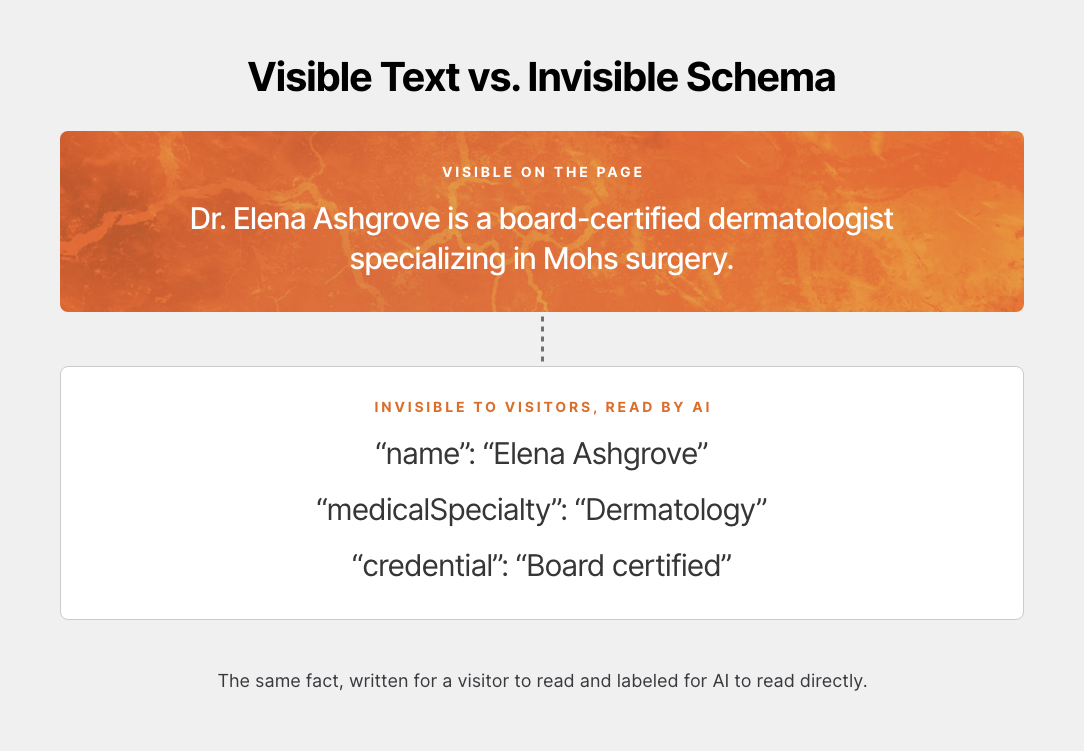
Schema markup can help communicate authority-related information by identifying a provider’s credentials directly, such as board certifications, specialties, and professional affiliations, so that systems processing the structured data can connect those details with the correct provider.
This data structuring is what using schema to communicate authority-related information in AI question answering actually means: giving an AI system a clearer understanding of the provider’s identity, credentials, and expertise.
Matching Schema Types to Your Practice
Not every schema type serves the same purpose for an elective healthcare practice website. Here’s how the most relevant types compare:
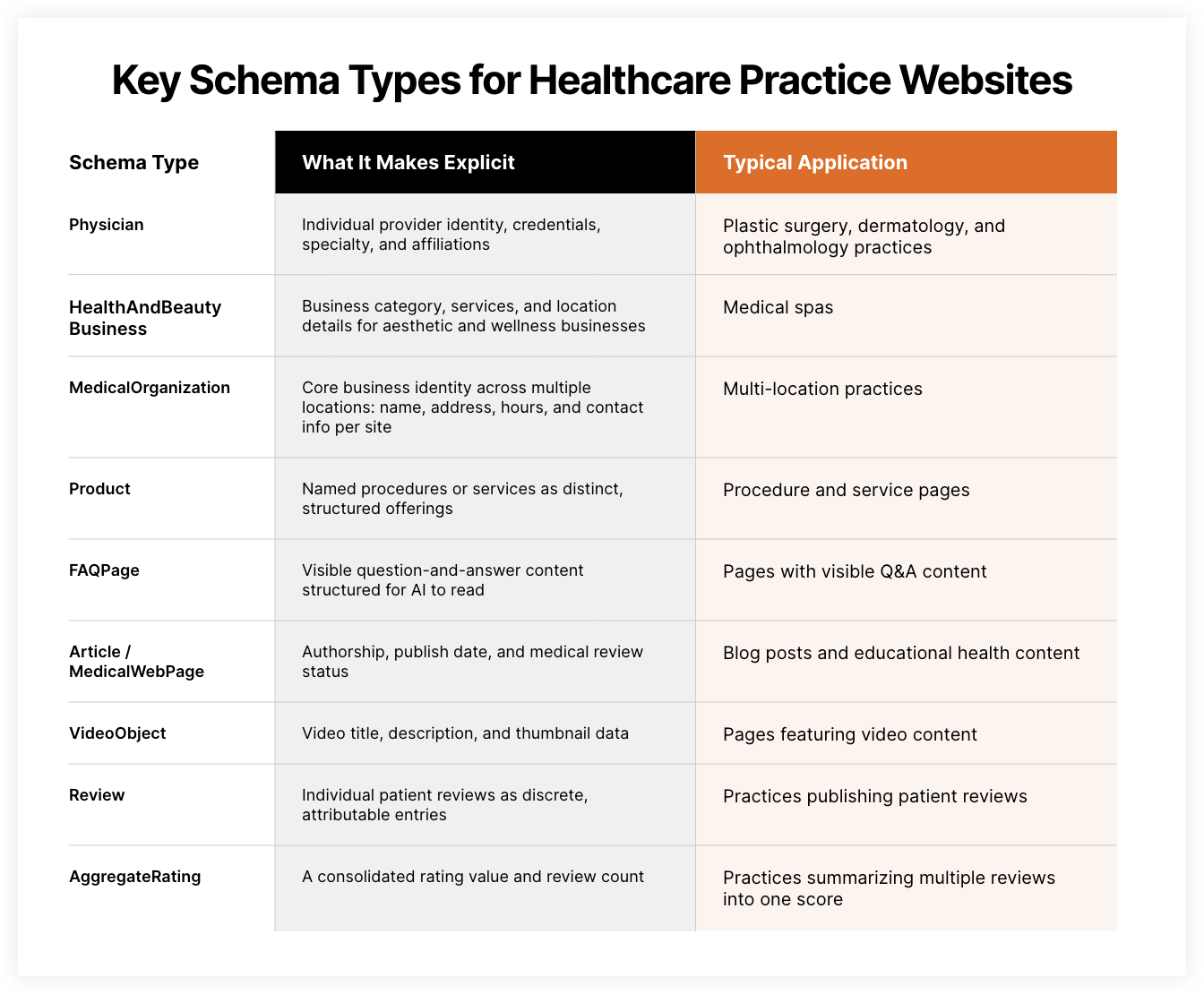
The primary schema type depends on the practice. Plastic surgery, dermatology, and ophthalmology practices use Physician, the most specific LocalBusiness type for a doctor’s office, while medical spas use HealthAndBeautyBusiness. Multi-location practices also use MedicalOrganization schema to connect individual locations with the larger business.
FAQ content is particularly useful for AI-generated results because it addresses patient questions directly. FAQPage schema identifies each visible question and its corresponding answer, making the content easier for search systems to interpret and connect with relevant queries, including those that trigger Google AI Overviews.
Article and MedicalWebPage schema label blog posts and educational content with authorship and publish date, along with medical review status when content has been clinically reviewed. VideoObject schema does similar work for video content, structuring the title, description, and thumbnail so AI systems can identify and reference video the same way they would a page of text.
Review schema identifies individual patient reviews associated with a procedure, while AggregateRating summarizes the overall rating and review count. When nested within Product schema on the relevant procedure page, this markup connects the feedback with the correct treatment and gives systems that process structured data a clear summary of the average rating and number of reviews associated with that treatment.
One caveat: the rating and review count must match the content displayed on the page and remain current as new reviews are added.
Best Practices for Schema Markup in AI Search
Choosing the right schema types is only half the work. It also needs to be implemented correctly so search and AI systems can interpret it. The following best practices can help make your schema markup accurate, consistent, and useful across traditional and AI-driven search.
#1. Match the schema to what’s visible on the page.
Schema should reflect the same information that a patient would see when reading the page itself. If the markup states one set of hours or services while the visible content says something else, the conflict makes the markup unreliable and may cause search systems to ignore it.
#2. Keep schema current.
Provider changes, new services, and updated hours need to be reflected in the markup as soon as they are updated on the page. Outdated schema can create conflicting signals by presenting information that’s no longer true.
#3. Use the most specific schema type available.
A general LocalBusiness type technically works, the most specific applicable type, such as Physician for a plastic surgery practice or HealthAndBeautyBusiness for a medical spa, gives search and AI systems more precise context.
#4. Validate markup before publishing.
Schema with structural errors may be ignored entirely, even if the underlying intent was correct. Use Google’s Rich Results Test to check schema supported for Google rich results and Schema.org’s Schema Markup Validator to validate other schema types and properties before publication.
#5. Avoid overly broad or inaccurate labeling.
Schema should describe a practice exactly as it is, not as it aspires to be. A worrying trend is the increase in marketing agencies using gray-hat tactics to get an AI system’s attention, such as listing a perfect 5.0 rating that the visible reviews don’t support.
While these tactics may seem like a shortcut to greater visibility, misleading schema creates significant legal and professional risks for a practice, especially as AI systems are increasingly able to cross-check data against other sources.
Schema Markup’s Role in AI Reputation and Trust
A practice’s reputation rarely lives in one place, and schema markup can clarify the review information published on its website. Reviews are spread across Google, Healthgrades, insurance directories, and social platforms, each with its own rating scale and format. Scattered, inconsistent numbers across sources are harder for AI to trust, even when every individual rating is genuine.
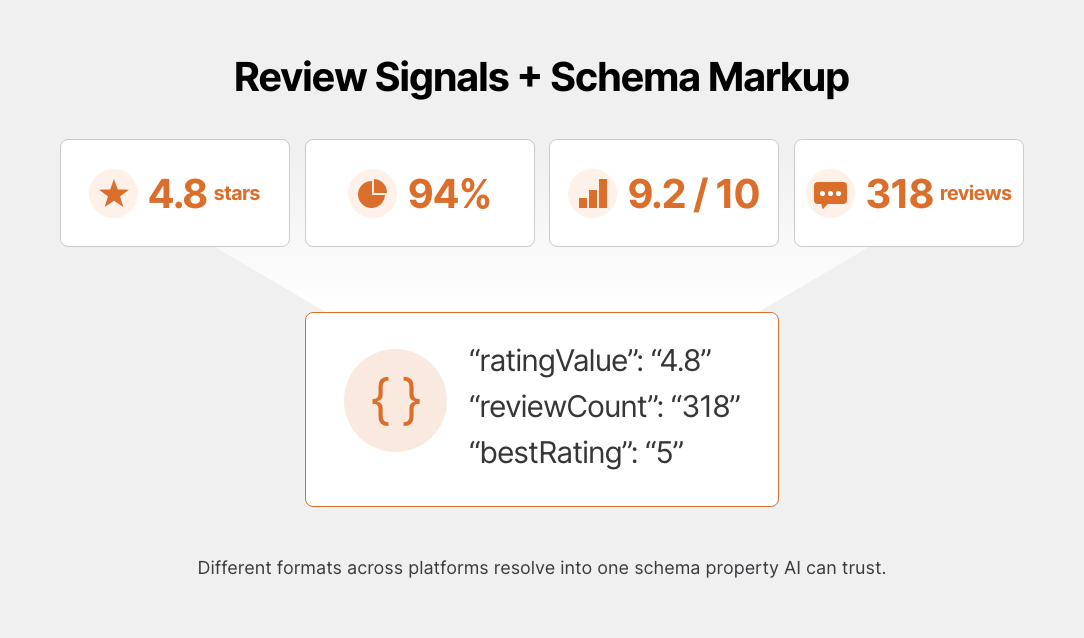
Review and AggregateRating schema consolidates this scattered data into one labeled, verifiable signal (a clear rating, review count, and source), in a format that an AI can read directly from the practice’s own site.
The rating value and review count in the markup must match what is visible on the page and stay current as new reviews are published. Tools like Etna’s own Reputation Ally product handle these changes automatically by updating the review schema in real time as new reviews come in.
The Bottom Line
The practices that AI search finds aren’t necessarily the ones with the most content; they’re the ones whose data AI can read, verify, and trust. If you want help building and maintaining a schema strategy that keeps your practice visible in AI search, contact us to learn more or connect with our team.

Leave a Comment