Patients don’t wait to ask their friends for a provider recommendation anymore. They search Google or ask AI. For elective healthcare practices, this shift raises a real question: Which ad format actually gets you in front of the right patient at the right moment?
Local Search Ads and traditional Paid Search ads often get lumped together, but they work differently, cost differently, and produce different kinds of leads. For an elective healthcare practice deciding where to invest its ad dollars, these differences are worth understanding before the next campaign goes live.
What Are Local Search Ads?
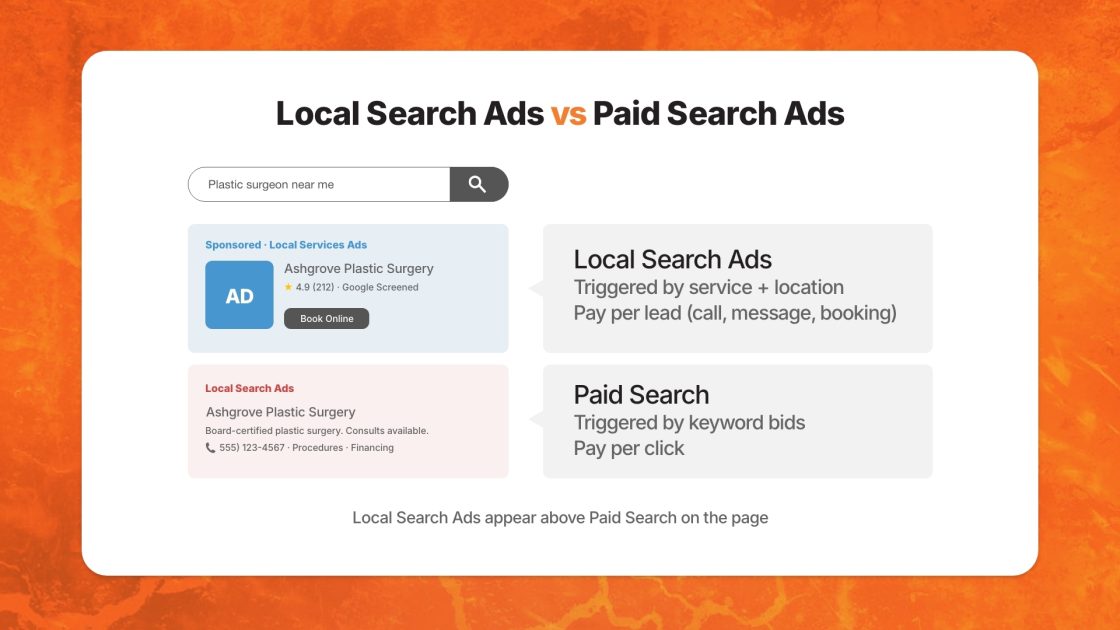
Local Search Ads are Google-verified ads that connect patients directly with nearby healthcare providers based on their search and location. Rather than a text link, these ads appear more like a business profile: a photo, star rating, a “Google Screened” or “Google Guaranteed” badge, and a direct call or booking button.
What Are Paid Search Ads?
Paid Search ads are the text-based ads that appear on Google when a business bids on specific keywords. These ads appear as a headline, a description, and a link to the practice’s website, often with extra details (called “extensions”) such as location, phone number, or sitelinks to specific pages.
Local Search Ads vs Paid Search Ads
| Local Search Ads | Paid Search Ads | |
| How it’s triggered | Local intent + service category match (e.g., “plastic surgeon near me”) | Keyword bidding, broader match types |
| Pricing model | Pay-per-lead (call, message, booking) | Pay-per-click |
| Where it appears | Top of page, above traditional search ads | Below the Local Services block, above organic results |
| Screening | Google vets and verifies the business | No built-in verification |
| Lead type | Ready to book, high local intent | Ranges from early research to ready to book |
Key Differences Between Local Search Ads and Paid Search
These differences shape more than when and where an ad appears. They also shape how much a practice pays, and who ends up on the other end of the phone.
Ad Triggers
Local Search Ads are triggered by service category and location. If someone nearby searches for that service, the ad can appear, regardless of the exact words they use. Paid Search ads are triggered by keyword bids. A practice’s ad appears when a search matches the specific terms it’s bidding on.
Placement on the Page
Local Search Ads sit above everything else on the page, including Paid Search ads, which means a prospective patient sees the verified, badge-carrying option before they ever reach a text ad.
Pricing Models
Local Search Ads charge for the outcome: a call, a message, or a booking. Paid Search charges for the click itself, regardless of what the patient does once they land on the site. For a practice tracking marketing spend, that’s a meaningful distinction: One model ties every dollar to an actual patient contact, the other ties it to traffic that may or may not convert.
Lead Quality
Lead quality tends to track with intent. A patient who calls from a Local Search Ad has usually already decided to reach out. A patient who clicks a Paid Search ad might still be comparing providers, checking credentials, or reading reviews before making that decision.
Choosing the Right Ad Strategy for Your Practice
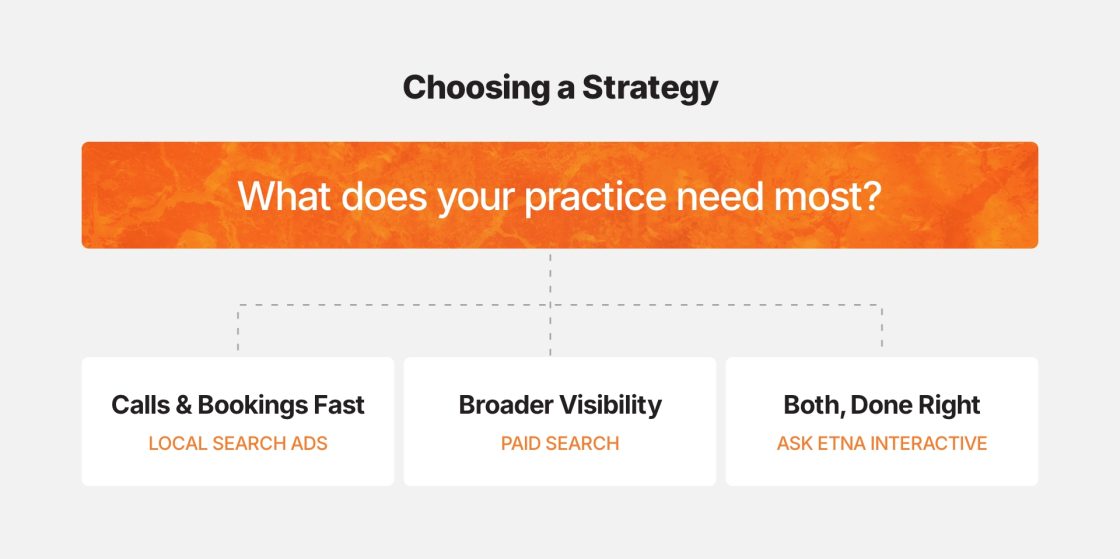
The right approach depends on what your practice needs most right now. A practice that wants immediate calls and bookings, especially for high-demand services like same-day appointments or new patient intake, tends to see strong results from Local Search Ads, since they connect directly with patients who are already ready to act.
Paid Search makes more sense when a practice needs broader visibility: competing for patients still comparing providers, targeting specific procedures by name, or showing up for searches beyond what Local Search Ads can reach. It also gives practices more control over the messaging, since the ad copy can be tailored to speak directly to a specific service or promotion.
Choosing a Combined Approach
The good news is, you don’t have to choose between one or the other. Running Local Search Ads and Paid Search together lets your practice capture patients at different points in their search: immediate, local intent through one channel, and broader consideration through the other.
There’s also a practical reason to run both from the start. Not every service category or location qualifies for Local Search Ads, and Google’s verification process takes time. Paid Search doesn’t have that waiting period, so it can maintain visibility while a Local Search Ads campaign is being approved, or serve as the primary channel if a practice doesn’t qualify at all.
Building and Managing the Right Mix
Local Search Ads and Paid Search both come with unique setup requirements, ongoing management, and pricing decisions that shift as a campaign runs.
Etna Interactive works with elective healthcare practices to build a paid and local search marketing strategy suited to their specific market, from verifying eligibility and managing bids to adjusting spend as performance data comes in. This ongoing management is what turns early campaign data into better bids, smarter budget decisions, and stronger results over time.
The Bottom Line
Local Search Ads and Paid Search aren’t competing for the same job. The practices that get the most from local advertising are the ones that match each format to what they’re actually trying to accomplish right now, whether that’s a full appointment book or a wider pool of prospective patients.
If you want help building a local advertising strategy that puts the right mix in front of the right patients, contact us to learn more or connect with our team.

Leave a Comment